Kamchatka and Siberia: Historical Records and Awakening of a Stable Platform
Kamchatka: A Historic Megathrust Earthquake and Violated Seismological Laws
On July 29, 2025, seismological stations around the world recorded one of the strongest earthquakes in the modern history of measurements. An earthquake with a magnitude of M 8.8 struck the Kamchatka Peninsula in the Russian Far East. This event ranks sixth among the strongest earthquakes since the beginning of modern seismological records, equal in magnitude to the historic Chile earthquake of February 27, 2010.1
Historical Context: Comparison with the Year 1952
In 1952, a very strong earthquake with a magnitude of M 9.0 occurred in Kamchatka—the fifth strongest in the history of observations. This earthquake caused a tsunami approximately 18 meters high, and estimates of the number of victims range between 2,300 and 14,0002. The hypocenter of this 1952 megathrust earthquake was at a depth of 22 km3, while the 2025 megathrust earthquake occurred at a depth of 35 km4.
It is commonly assumed that mega-earthquakes with magnitudes around M9 in megathrust zones represent the release of a slip deficit that accumulates at the boundary between lithospheric plates over centuries. The 2025 Kamchatka event (M 8.8–8.9), however, judging by the distribution of aftershocks, ruptured practically the same segment as the M 9.0 earthquake of 1952. This exceptionally short interval between two large ruptures challenges conventional ideas about the course of the seismic cycle.5
The results of a Japanese study shown in Fig. 1 suggest that the rupture in 2025 was accompanied by fault slips exceeding 9 meters across a large area from southern Kamchatka to the northern Kuril Islands. This slip significantly exceeds the approximately 6 meters of plate convergence accumulated since 1952 and spatially coincides with the area of maximum slip during the 1952 event. In zones of the largest slip, approximately double acceleration of slip velocity occurred, probably due to dynamic stresses and complex frictional behavior on the fault. After the main rupture, aftershocks with low-angle normal faulting appeared in the plate interface area, suggesting that during the main earthquake there was dynamic overshoot of equilibrium shear stress on the fault. The authors of the study indicate that such complete stress release is unusual even among megathrust earthquakes.
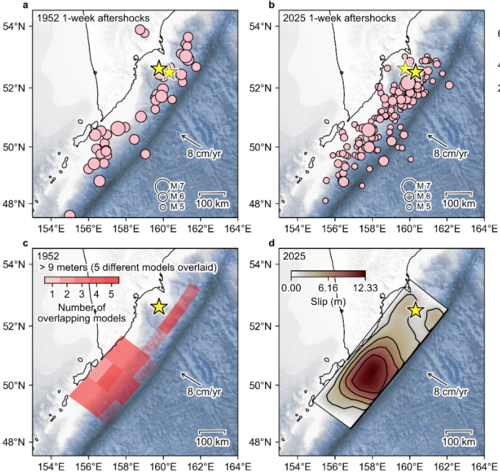
Fig. 1: Comparison of megathrust earthquakes in Kamchatka in 1952 and 2025.
(a, b) Aftershocks following the events of 1952 and 2025 during the following week (November 4–11, 1952; July 29 – August 5, 2025). The black-outlined star represents the epicenter of the main shock of the respective events. Pink circles represent aftershocks. For comparison, the gray-outlined star represents the epicenter of the other event.
(c, d) Coseismic slip models for the events of 1952 and 2025.
Source: https://seismica.library.mcgill.ca/article/view/2012/2650
The following Figures 2–5 show a comparison of the number of earthquakes located in the zone (155.0° E –163.5° E, 49.5° N – 55° N), which includes the immediate aftershocks (not background seismicity) of the two main megathrust earthquakes (1952 M 9.0 and 2025 M 8.8) falling within the 1–2 rupture-length criterion used by the USGS for aftershock zones6. For the following comparison of direct aftershocks, 1× the rupture length was chosen as the boundary of the seismic zone. For the 1952 megathrust earthquake, the rupture length was estimated at approximately 600–700 km7. For the 2025 megathrust earthquake, the rupture length was estimated at approximately 600 km8.
Methodological Justification for the Selection of Seismic Zone Boundaries for the Comparison of Aftershocks Following the Kamchatka Megathrust Earthquakes of 1952 and 2025
The analytical spatial window was defined as 155.0° E – 163.5° E, 49.5° N – 55.0° N, with the aim of capturing the direct aftershocks associated with the megathrust ruptures of the Kamchatka 1952 (M 9.0) and 2025 (M 8.8) earthquakes while maintaining maximum comparability between the two events.
Choice of Longitudinal Boundaries (155.0 – 163.5° E)
The eastern and western boundaries were selected so that they fully include the longitudinal extent of both coseismic ruptures, as evident from the spatial distribution of early aftershocks and from coseismic slip models (Yagi et al. 2025, Fig. 1). The chosen range exceeds the longitudinal length of the shorter rupture (2025) while covering the entire core of the longer rupture from 1952, without significant inclusion of distant or tectonically unrelated seismicity.
Choice of the Northern Boundary (55.0° N)
The northern boundary of the analytical window was established to include the northern edge of the observed aftershock zones of both events.
Key Justification for the Southern Boundary (49.5° N)
The southern boundary of the analytical window (49.5° N) was deliberately chosen conservatively, based on a combination of geometric, seismological, and tectonic criteria. As shown in the study by Yagi et al. (2025, Fig. 1c–d), continuous coseismic slip and the coherent core of aftershocks of both events do not extend south of approximately 49.5° N. Seismicity observed south of this boundary is sparse, spatially discontinuous, and represents a transition toward the tectonic environment of the Kuril Arc.
Including areas south of 49.5° N would therefore lead to:
mixing of megathrust aftershocks with transitional or remotely triggered seismicity
reduced tectonic homogeneity of the analyzed area
potential distortion of the comparison of aftershock properties of the two events
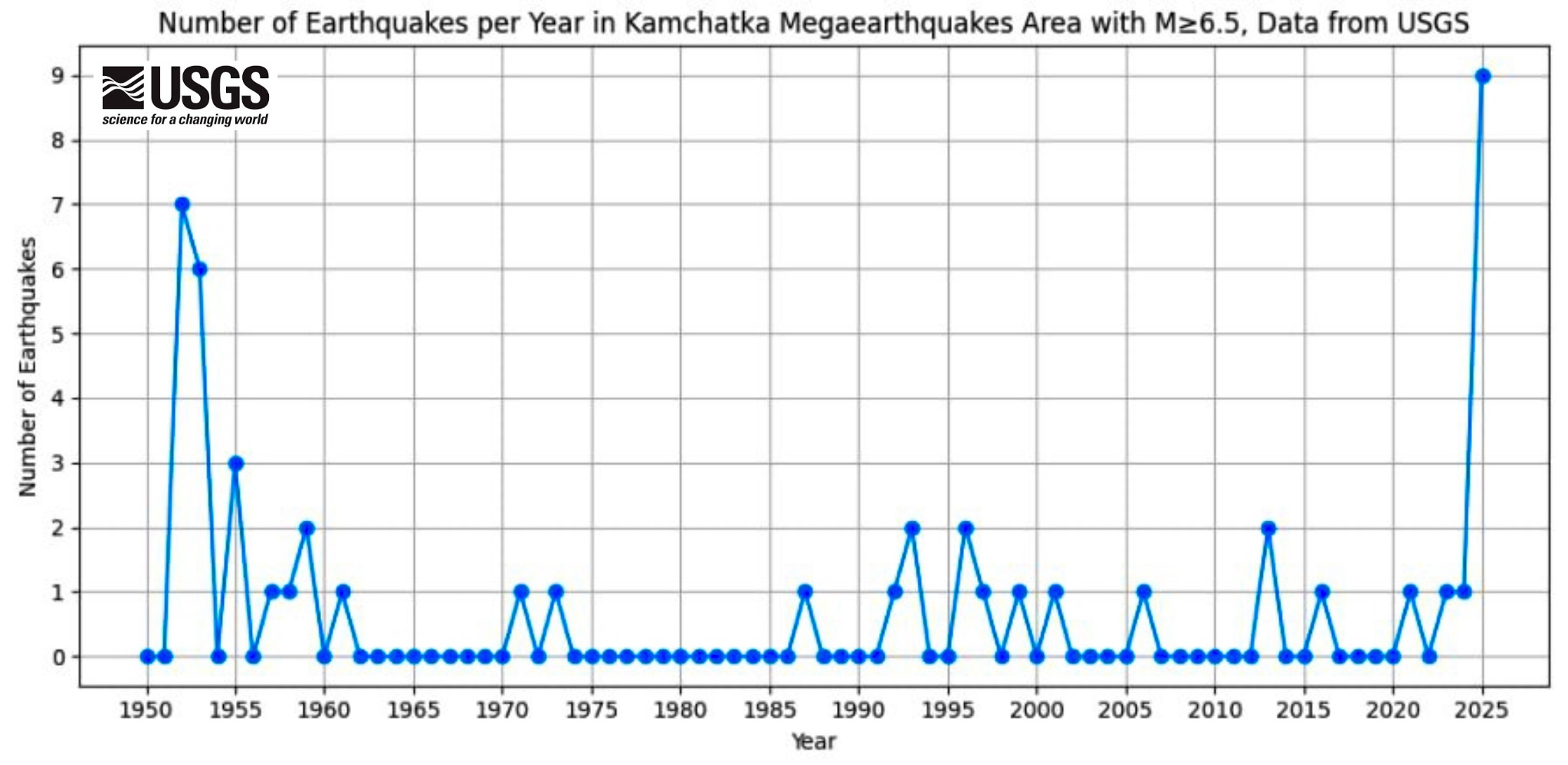
Fig. 2: Number of earthquakes with M ≥ 6.5 in the seismic zone of the Kamchatka megathrust earthquakes. Data: USGS https://earthquake.usgs.gov/earthquakes/search/
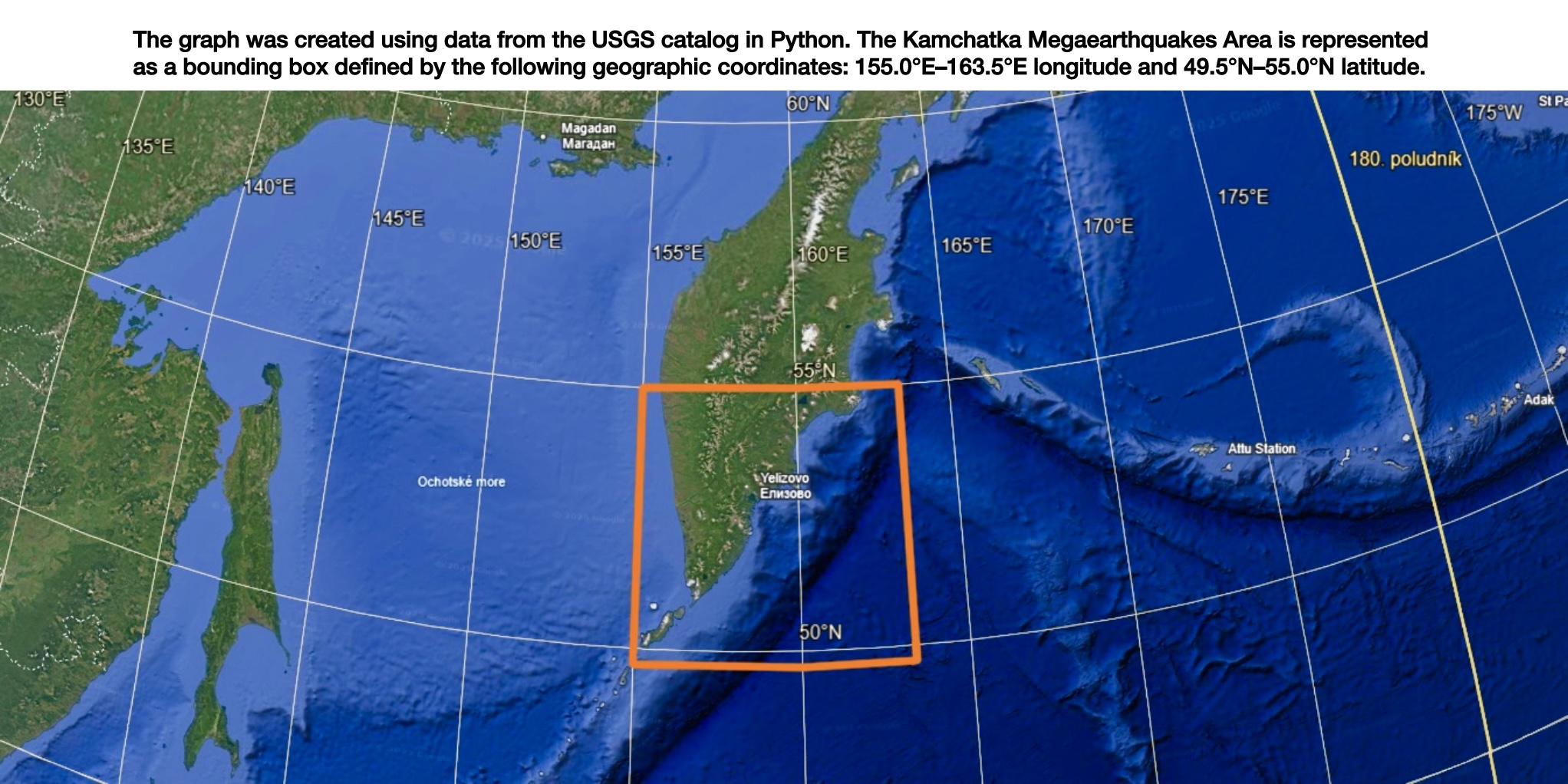
Fig. 3: Zone used for comparing earthquakes before and after the Kamchatka megathrust earthquakes. Source: Google Earth, own modification
The graph from the USGS catalog (Fig. 2) shows that the occurrence of earthquakes with magnitude M ≥ 6.5 in the Kamchatka megathrust region (155.0° E – 163.5° E, 49.5° N – 55.0° N) is strongly concentrated in periods directly associated with megathrust earthquakes.
The November 4, 1952 megathrust earthquake had 7 aftershocks of magnitude M ≥ 6.5 in the first five months after the event (November 4, 1952 – April 4, 1953). A similar but even more pronounced increase in activity is observed in 2025 following the M 8.8 megathrust earthquake, which represents the highest annual frequency of strong foreshocks and aftershocks within the entire analyzed time interval.
Although this earthquake was two tenths of a magnitude unit weaker, it already had four foreshocks with magnitude M ≥ 6.5 and four aftershocks with magnitude M ≥ 6.5 within five months after its occurrence (July 29, 2025 – December 31, 2025).
The aftershock period is likely longer, but the current analysis has access only to the first five months following the latest megathrust earthquake.
Outside these two periods, the occurrence of earthquakes M ≥ 6.5 is sporadic to zero, confirming that strong seismicity in this region is primarily linked to megathrust ruptures and their subsequent aftershock sequences.
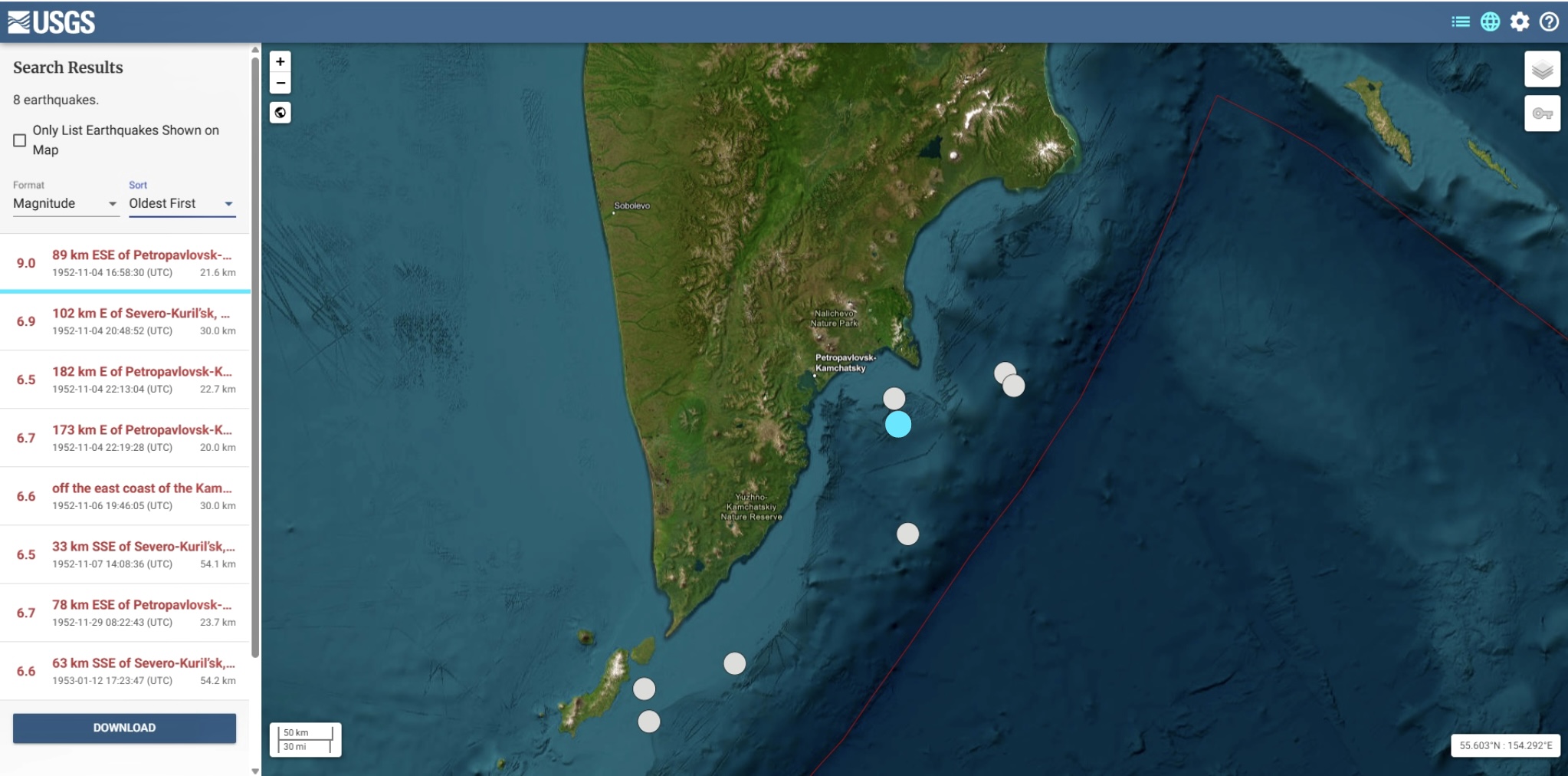
Fig. 4: List of earthquakes and their locations with magnitude greater than M 6.5 in the aftershock zone of the 1952 megathrust earthquake and the first three months of 1953 (USGS): https://earthquake.usgs.gov/earthquakes/search/
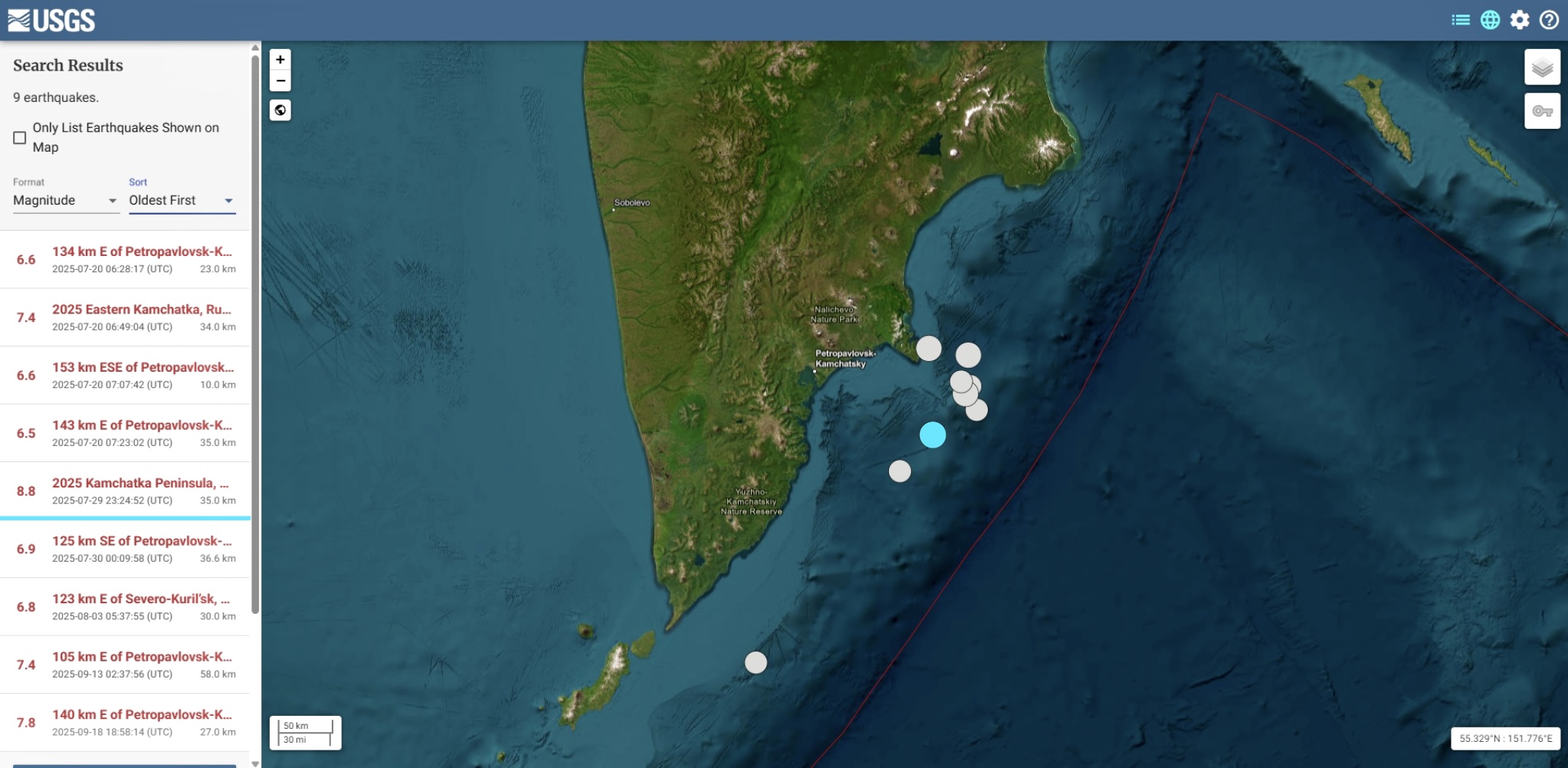
Fig. 5: List of earthquakes and their locations with magnitude greater than M 6.5 in the foreshock and aftershock zone of the 2025 megathrust earthquake (USGS): https://earthquake.usgs.gov/earthquakes/search/
In addition, the November 4, 1952 megathrust earthquake (M 9) had no foreshock or aftershock with magnitude M ≥ 7, whereas the July 29, 2025 megathrust earthquake (M 8.8) had one strong foreshock (M 7.4) and two strong aftershocks (M 7.4 and M 7.8) in the same year.
Aftershocks are compared for a five-month period following the megathrust earthquake:
July 20, 2025: M 7.4 (Kamchatka) – initially considered the main earthquake
July 29, 2025: M 8.8 (Kamchatka) – the actual megathrust earthquake
September 13, 2025: M 7.4 (Kamchatka) – aftershock
September 18, 2025: M 7.8 (Kamchatka) – aftershock
Critical Difference: The historic 1952 megathrust earthquake had no foreshock or aftershock with magnitude M 7+ in the first months after the earthquake9. The Kamchatka earthquakes of 2025 therefore behave fundamentally differently from the historical precedent.
Earthquakes with magnitude M 6.5 were chosen in the comparative study because they have been reliably recorded since at least the 1950s.
Violation of Båth’s Law
Even more remarkable than the megathrust earthquake itself is the character of the foreshocks and aftershocks, which violate basic seismological laws. According to Båth’s law10, the strongest aftershock is typically about 1.2 magnitude units weaker than the main earthquake. However, this year’s Kamchatka megathrust earthquake dramatically violates this pattern.
“All seismologists thought that the aftershock that occurred on September 13 (magnitude 7.4) was already the strongest expected according to seismological laws. Usually it is about 1.2 magnitudes lower than the main shock. But an even stronger one occurred,” said Yuri Vinogradov, director of the Unified Geophysical Service of the Russian Academy of Sciences.11
On February 27, 2010, a megathrust earthquake occurred in Chile with the same magnitude (M 8.8) as this year’s Kamchatka megathrust earthquake. Together these earthquakes share sixth place among the strongest earthquakes in recorded history. Both, Chilean12 and Kamchatka13 earthquakes occurred at the same depth, with hypocenters at 35 km.
Braile (2010) analyzed the direct foreshocks and aftershocks (not background seismicity) of the Chilean megathrust earthquake within its immediate seismic zone (Figs. 6-7)14. Dengler (2025) analyzed the large foreshocks and aftershocks of the Kamchatka megathrust earthquake in its immediate seismic zone (Fig. 8)15.
Comparison of the foreshock and aftershock sequences of the 2025 Kamchatka megathrust earthquake with the equally strong 2010 Chile earthquake (M 8.8) shows significant differences. In the case of the Chilean earthquake, no foreshock stronger than M 6.0 was recorded, and no direct aftershock stronger than M 7.0 occurred after the main shock.
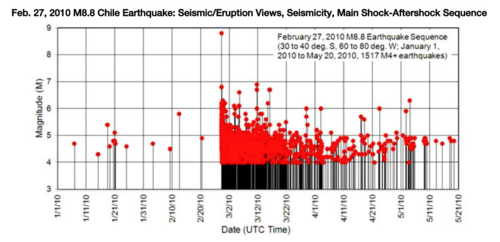
Fig. 6: Foreshocks and aftershocks of the 2010 Chile megathrust earthquake, source: https://web.ics.purdue.edu/~braile/edumod/chile/chile.htm
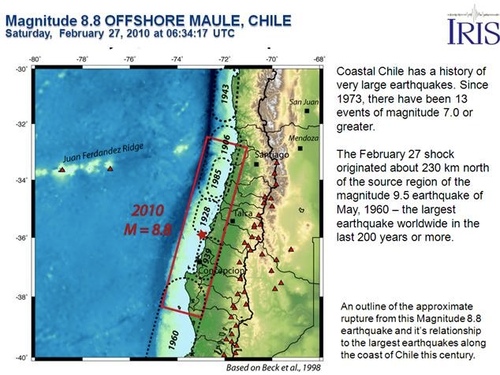
Fig. 7: Aftershock zone of the 2010 Chile megathrust earthquake, source: https://web.ics.purdue.edu/~braile/edumod/chile/chile.htm
In Kamchatka in 2025, the course of seismic activity was significantly more intense. The main earthquake was preceded by at least seven foreshocks with magnitude greater than M 6.0, two of which even exceeded M 7.0. Already a year earlier, in 2024, an M 7.0 earthquake occurred in the same area, which several seismologists interpreted as a release of accumulated stress. Subsequent developments, however, showed that this earthquake was more likely a precursor to a much stronger event. After the main shock, exceptionally strong aftershocks followed: on September 13, 2025 with a magnitude of M 7.4 and on September 18, 2025 with a magnitude of M 7.8.
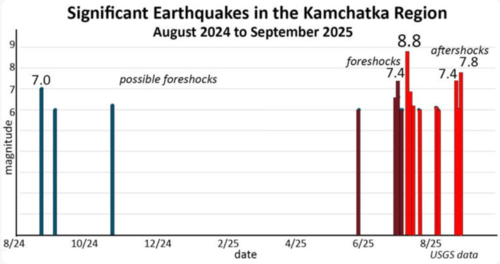
Fig. 8: Foreshocks and aftershocks with magnitude above 6 of the Kamchatka megathrust earthquake sequence 2024–2025, source: https://www.msn.com/en-us/public-safety-and-emergencies/natural-disasters/lori-dengler-a-very-large-aftershock-reminder-that-the-kamchatka-earthquake-sequence-is-not-over/ar-AA1MYowB
Classical seismological models predict that the largest aftershock should be approximately 1.2 magnitudes smaller than the main shock. In the case of the Kamchatka sequence, however, multiple strong aftershocks were recorded, especially one with M 7.8, which clearly violates this law. Some aftershocks exceeded M 7.0, which in itself represents a strong earthquake.
Moreover, even among weaker shocks there is a significant difference between these two megathrust earthquakes with the same M 8.8 magnitude and approximately the same hypocentral depth. While the 2010 Chile megathrust earthquake generated approximately 1000 aftershocks with M ≥ 4.5 (Fig. 10), the 2025 Kamchatka megathrust earthquake produced significantly more—approximately 1700 (Fig. 9). These differences are clearly illustrated in the graphs in Figures 9–10, which compare the number of aftershocks in both cases.
The coordinates used to capture the aftershock zone of the Chilean megathrust earthquake (75.0° W – 71.0° W and 38.0° S – 32.5° S) were selected to most accurately cover the main area of foreshock and aftershock seismic activity associated with the 2010 M 8.8 Chile megathrust earthquake. This spatial region includes the segment of the boundary between the Nazca and South American plates, where the main rupture process occurred, and at the same time covers the longitudinal and transverse extent of the observed aftershock region identified in seismological catalogs.
The west–east extent (75° W – 71° W) reaches from the oceanic portion of the fault zone to continental areas, enabling the capture of seismic activity located along the entire shear interface and within the overlying continental crust. The north–south extent (38.0° S – 32.5° S) corresponds to the length of the main rupture zone of the megathrust earthquake and includes areas with the highest density of aftershocks.
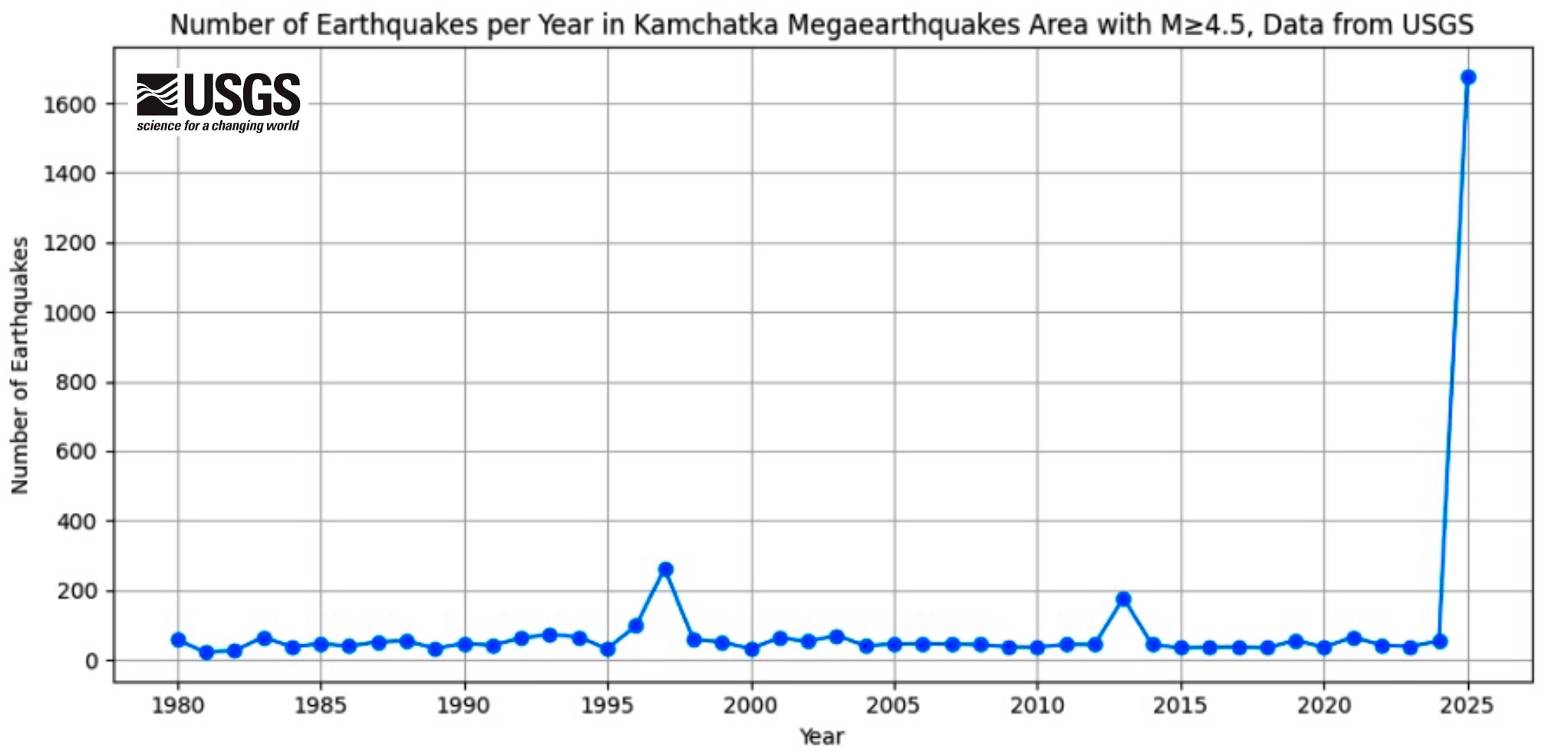
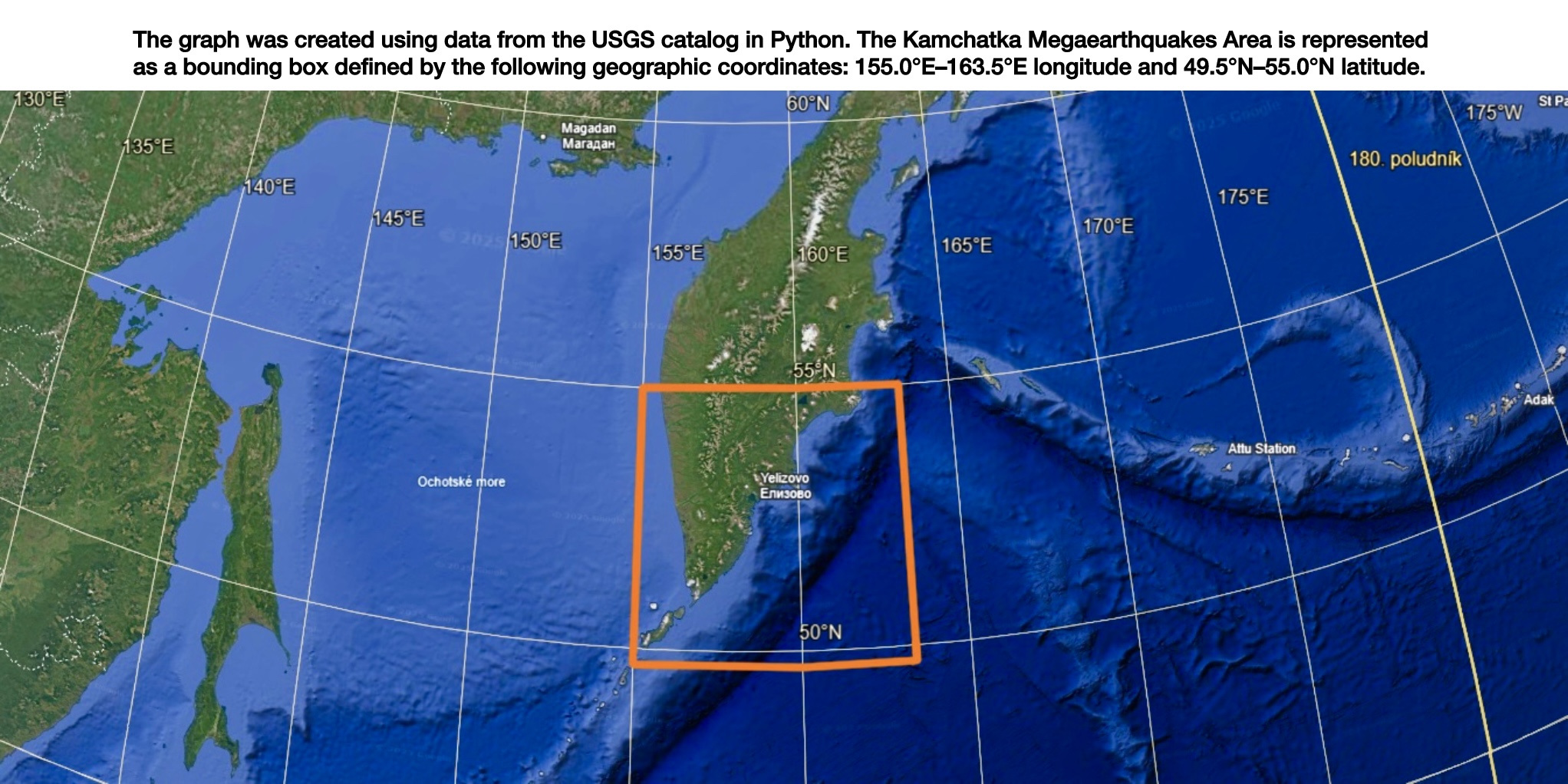
Fig. 9: Earthquakes within M ≥ 4,5 in Kamchatka, analyzed spatial area: 155.0° E - 163.5° E, 49.5° N - 55.0° N, data source: USGS, image source: Google Earth, own modification
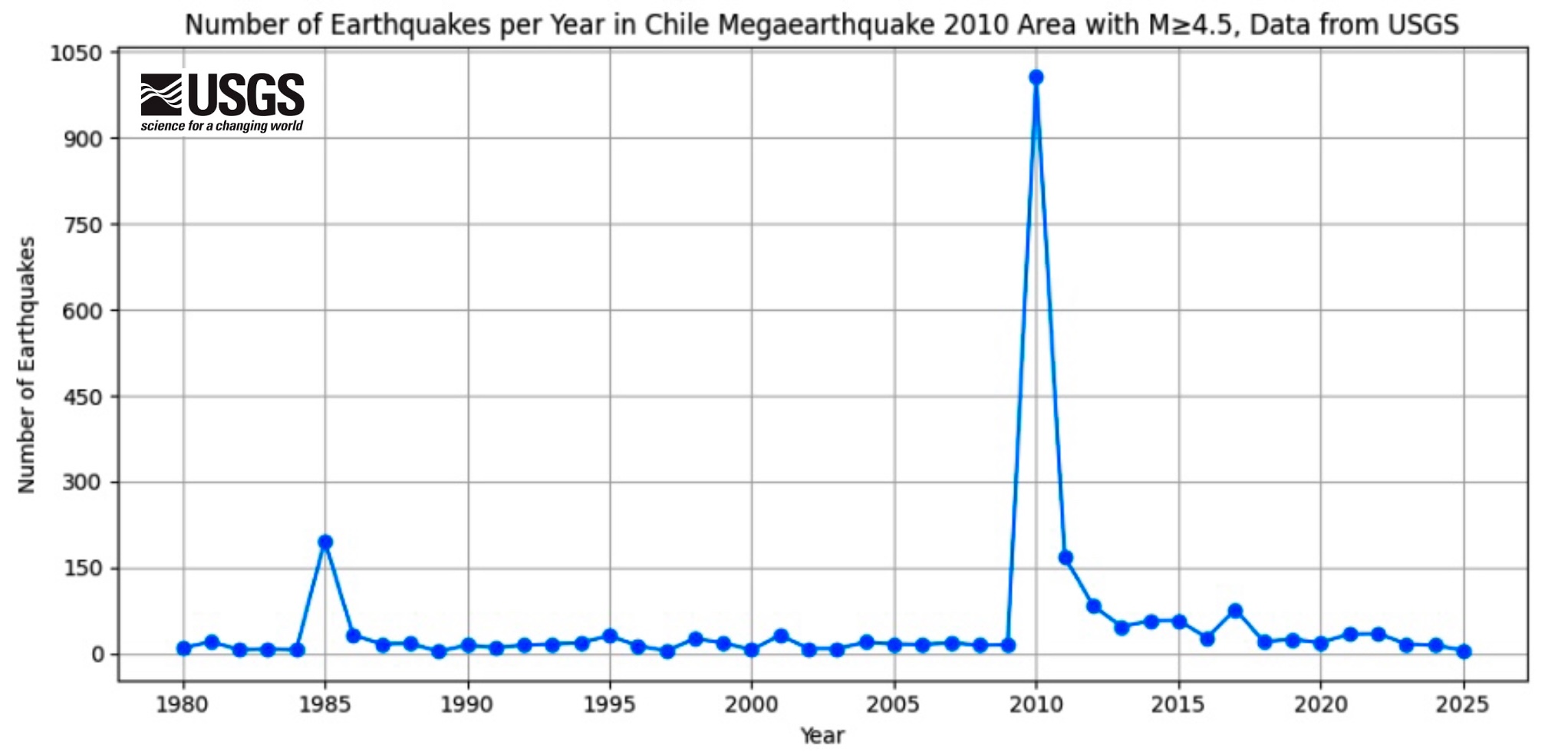
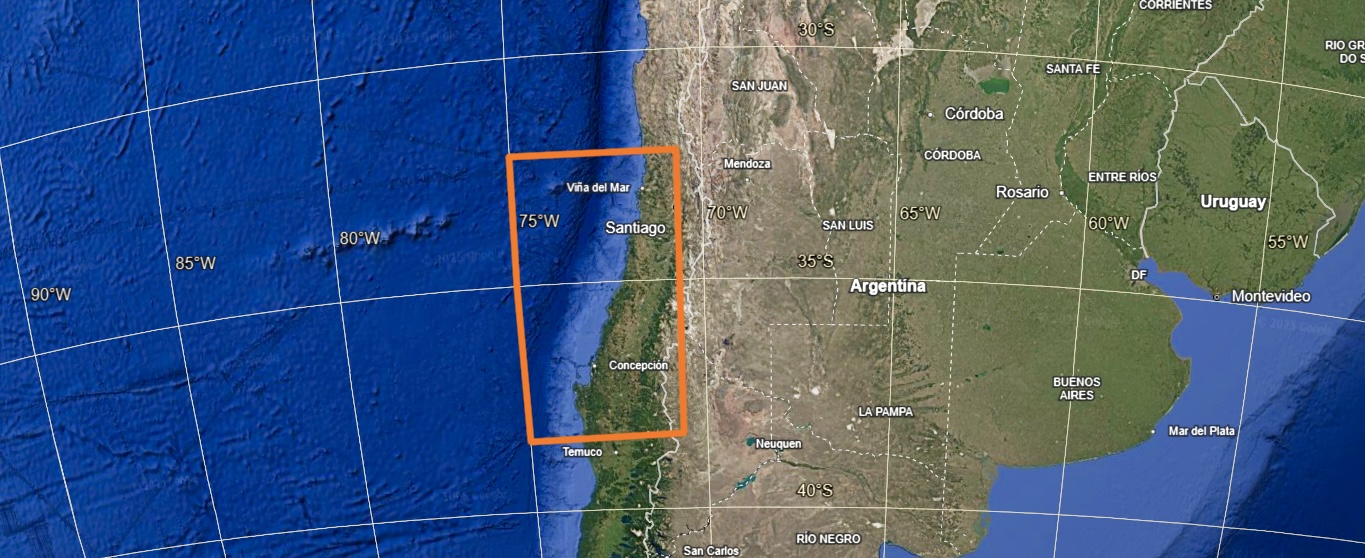
Fig. 10: Earthquakes with M ≥ 4,5 in Chile, analyzed spatial area: 75.0° W - 71.0° W, 38.0° S - 32.5° S, data source: USGS, image source: Google Earth, own modification
Such behavior may indicate that there has not been merely a single release of accumulated stress, but that the entire region may be undergoing a process of fundamental tectonic reorganization.
Volcanic Activity in Kamchatka: Awakening of Six Volcanoes at Once
Only a few months after this year’s Kamchatka megathrust earthquake, six volcanoes erupted simultaneously on the Kamchatka Peninsula. According to scientists, this is an extremely unusual phenomenon, last observed in 1737 after a magnitude M 9.0 earthquake. Yuri Demyanchuk, head of the volcanological station in the village of Klyuchi, stated that in five decades of work in Kamchatka he had never seen such extensive volcanic activity.16
Kamchatka is home to 29 active volcanoes and dozens of potentially active ones. In 2025, a significant escalation of activity occurred not only in traditional “workhorse” volcanoes such as Klyuchevskaya Sopka (the highest active volcano in Eurasia at 4750 meters) but also in volcanoes that had been dormant for decades or even centuries.
Particularly exceptional is Krasheninnikov Volcano, which erupted for the first time in approximately 600 years—its last known eruption dates to the 15th century. Kronotsky Volcano erupted after 100 years of dormancy. The awakening of long-dormant volcanoes may signal fundamental changes in deep magmatic systems.
Siberian Arctic: Unprecedented Activity on a Stable Platform
One of the most mysterious and potentially most significant phenomena of 2025 is the unusually strong seismic activity recorded in the regions of Krasnoyarsk and Yakutia (Figs. 11–12). This fact is geologically extremely unusual, because the region lies in the heart of the Siberian Platform, one of the oldest and most stable tectonic structures on Earth.
The Siberian Platform is a cratonic region, meaning a portion of continental crust more than two billion years old, characterized by extreme stability. In such regions, strong earthquakes are extremely rare, because the absence of active tectonic boundaries means minimal accumulated stress. It is therefore all the more surprising that in 2025 this region began to exhibit seismic activity atypical for it.17 18
Sergey Shibayev, director of the Yakutsk branch of the Federal Research Center “Unified Geophysical Service of the Russian Academy of Sciences,” noted that all schools, stadiums, and government institutions in Yakutsk should be designed and built with consideration for seismic hazards of magnitude 7.19
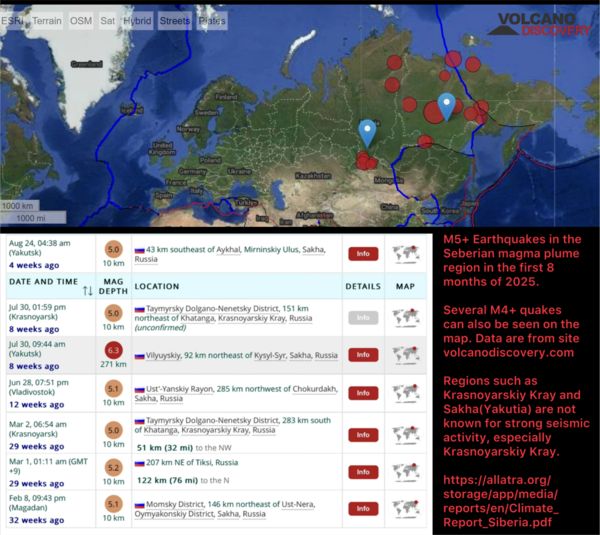
Fig. 11: Earthquakes with magnitude greater than M 5 in the Krasnoyarsk region and Yakutia during the first eight months of 2025. Sources: https://www.volcanodiscovery.com/earthquakes/russia/sakha/archive/2025.html, https://www.volcanodiscovery.com/earthquakes/russia/krasnoyarskiy-kray/archive/2025.html

Fig. 12: “An earthquake occurred in northern Krasnoyarsk Territory” and “The number of earthquakes in Yakutia is increasing.” Sources: https://gazetazp.ru/news/obschestvo/na-severe-krasnojarskogo-kraja-proizoshlo-zemletrjasenie.html, https://ysia.ru/v-yakutii-rastet-kolichestvo-zemletryasenij-uchenyj-rasskazal-o-sejsmicheskoj-opasnosti/
References:
“Lists of earthquakes” (2026) Wikipedia. Available at: https://en.wikipedia.org/w/index.php?title=Lists_of_earthquakes&oldid=1343016360 (Accessed: March 16, 2026).
“1952 Severo-Kurilsk earthquake” (2026) Wikipedia. Available at: https://en.wikipedia.org/w/index.php?title=1952_Severo-Kurilsk_earthquake&oldid=1333427734 (Accessed: March 16, 2026).
M 9.0 - 89 km ESE of Petropavlovsk-Kamchatsky, Russia. Available at: https://earthquake.usgs.gov/earthquakes/eventpage/official19521104165830_30/executive (Accessed: March 16, 2026).
M 8.8 - 2025 Kamchatka Peninsula, Russia Earthquake. Available at: https://earthquake.usgs.gov/earthquakes/eventpage/us6000qw60/executive (Accessed: March 16, 2026).
Yagi, Y. et al. (2025) “Breaking the Cycle: Short Recurrence and Overshoot of an M9-class Kamchatka Earthquake,” Seismica, 4(2). Available at: https://doi.org/10.26443/seismica.v4i2.2012.
Foreshocks, aftershocks - what’s the difference? | U.S. Geological Survey (2024). Available at: https://www.usgs.gov/faqs/foreshocks-aftershocks-whats-difference (Accessed: March 16, 2026).
Johnson, J.M. and Satake, K. (1999) “Asperity Distribution of the 1952 Great Kamchatka Earthquake and its Relation to Future Earthquake Potential in Kamchatka,” Pure and Applied Geophysics, 154(3–4), pp. 541–553. Available at: https://doi.org/10.1007/s000240050243.
Xu, D., Wang, W. and Ren, Z. (2025) “Preliminary slip distribution of the July 29, 2025 MW 8.8 Kamchatka, Russia earthquake,” Earthquake Research Advances, p. 100427. Available at: https://doi.org/10.1016/j.eqrea.2025.100427.
Significant Earthquakes - 1952. Available at: https://earthquake.usgs.gov/earthquakes/browse/significant.php?year=1952 (Accessed: March 16, 2026).
Helmstetter, A. and Sornette, D. (2003) “Bath’s law Derived from the Gutenberg-Richter law and from Aftershock Properties,” Geophysical Research Letters, 30(20), p. 2003GL018186. Available at: https://doi.org/10.1029/2003GL018186.
На Камчатке произошло новое землетрясение (2025) Национальная Служба Новостей - НСН. Available at: https://nsn.fm/incident/novoe-moschnoe-zemletryasenie-na-kamchatke-privelo-seismologov-v-zameshatelstvo (Accessed: March 16, 2026).
Pirti, A. (2024) “Investigation and prediction of the 2010 Maule, Chile earthquake by using GNSS on 25, 26 and 27 February 2010,” Journal of South American Earth Sciences, 133, p. 104702. Available at: https://doi.org/10.1016/j.jsames.2023.104702.
M 8.8 - 2025 Kamchatka Peninsula, Russia Earthquake. Available at: https://earthquake.usgs.gov/earthquakes/eventpage/us6000qw60/executive (Accessed: March 16, 2026).
Braille, L. (2010). Feb. 27, 2010 M8.8 Chile Earthquake: Seismic/Eruption Views, Seismicity, Main Shock-Aftershock Sequence. Available at: https://web.ics.purdue.edu/~braile/edumod/chile/chile.htm (Accessed: March 16, 2026).
Lori Dengler | A very large aftershock reminder that the Kamchatka earthquake sequence is not over (2025). Available at: https://www.msn.com/en-us/public-safety-and-emergencies/natural-disasters/lori-dengler-a-very-large-aftershock-reminder-that-the-kamchatka-earthquake-sequence-is-not-over/ar-AA1MYowB (Accessed: March 16, 2026).
Volcano in Russia’s Kamchatka ejects ash up to 9.2 km high (2025) ap7am.com. Available at: https://www.ap7am.com/en/110864/volcano-in-russias-kamchatka-ejects-ash-up-to-92-km-high (Accessed: March 16, 2026).
“Землетрясение в Хатанге нехарактерное явление для сейсмически спокойного Таймыра” (2025) Новости «Северного Города», 5 March. Available at: https://news.sgnorilsk.ru/2025/03/05/zemletryasenie-v-hatange-neharakternoe-yavlenie-dlya-sejsmicheski-spokojnogo-tajmyra/ (Accessed: March 16, 2026).
Силой 6 - 8 баллов. Ученые оценили прогноз мощных землетрясений в Якутии, Дзен | Статьи (2024). Available at: https://dzen.ru/a/ZqjG6iMaR2Fxfei4 (Accessed: March 16, 2026).
Горохова, М. (2025) В Якутии растет количество землетрясений. Ученый рассказал о сейсмической опасности — ЯСИА, Новости Якутии и Якутска — свежие новости онлайн на сайте ysia.ru — ЯСИА. Available at:https://ysia.ru/v-yakutii-rastet-kolichestvo-zemletryasenij-uchenyj-rasskazal-o-sejsmicheskoj-opasnosti/ (Accessed: March 16, 2026).