Jan Mayen and Svalbard: Awakening of the Arctic Volcanic Zone
The region around the islands of Jan Mayen and Svalbard in the Arctic Ocean has experienced a significant increase in seismic activity in recent years, reaching new peaks in 2025. This area, often overlooked due to its remoteness and extreme climatic conditions, appears to be geologically far more active than previously assumed.
While normally no more than about 50 earthquakes with magnitude M 4+ per year were recorded in the Jan Mayen and Svalbard region, in recent years the number has exceeded 70+ (Fig. 1-2).
This more than twofold increase in seismic activity in a region historically considered relatively quiet is geologically significant. Arctic regions generally exhibit lower seismic activity than tectonically active belts such as the Ring of Fire, which is why any substantial increase deserves attention.
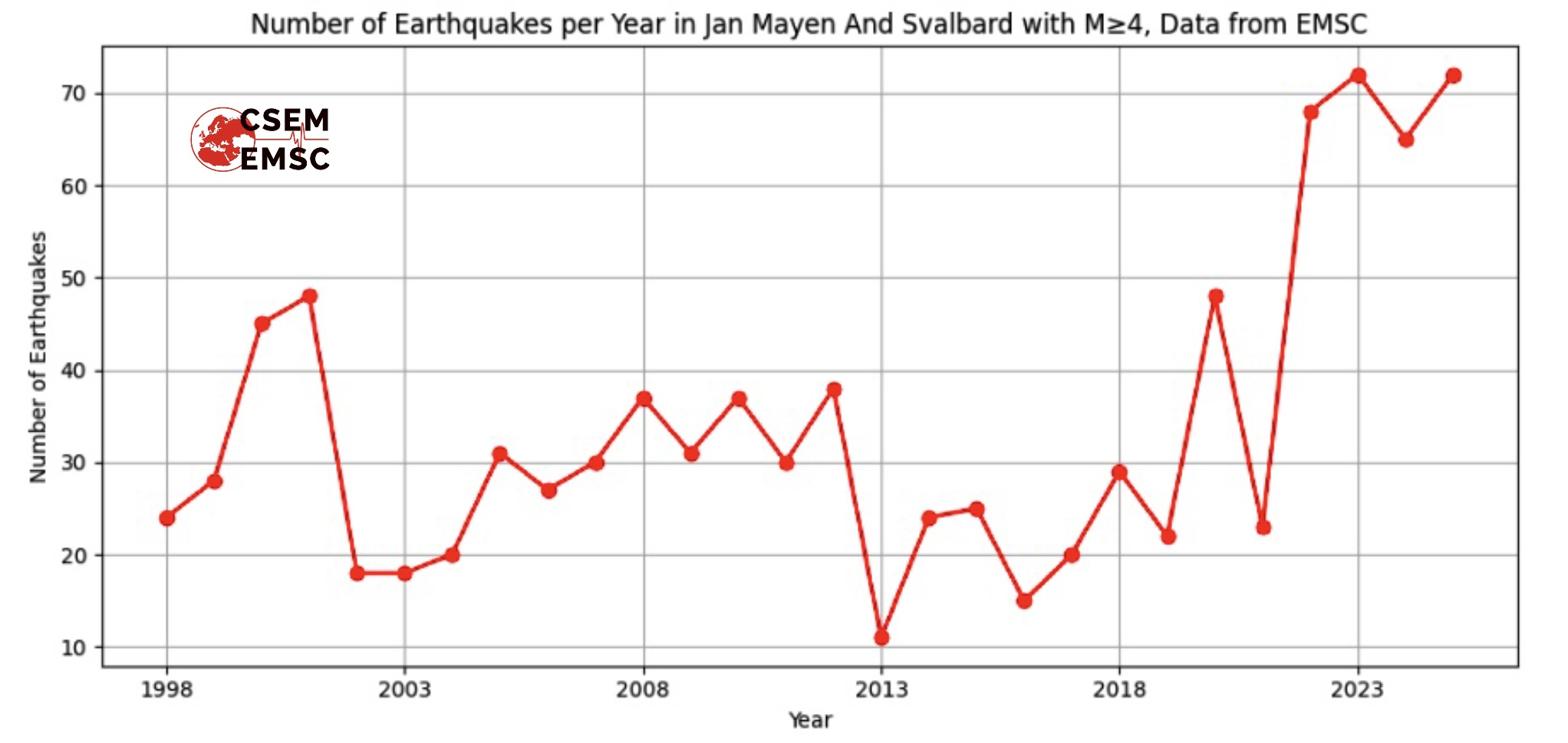
Fig. 1: Number of earthquakes with M ≥ 4 around the islands of Jan Mayen and Svalbard, data source: EMSC https://www.emsc-csem.org/Earthquake_information/
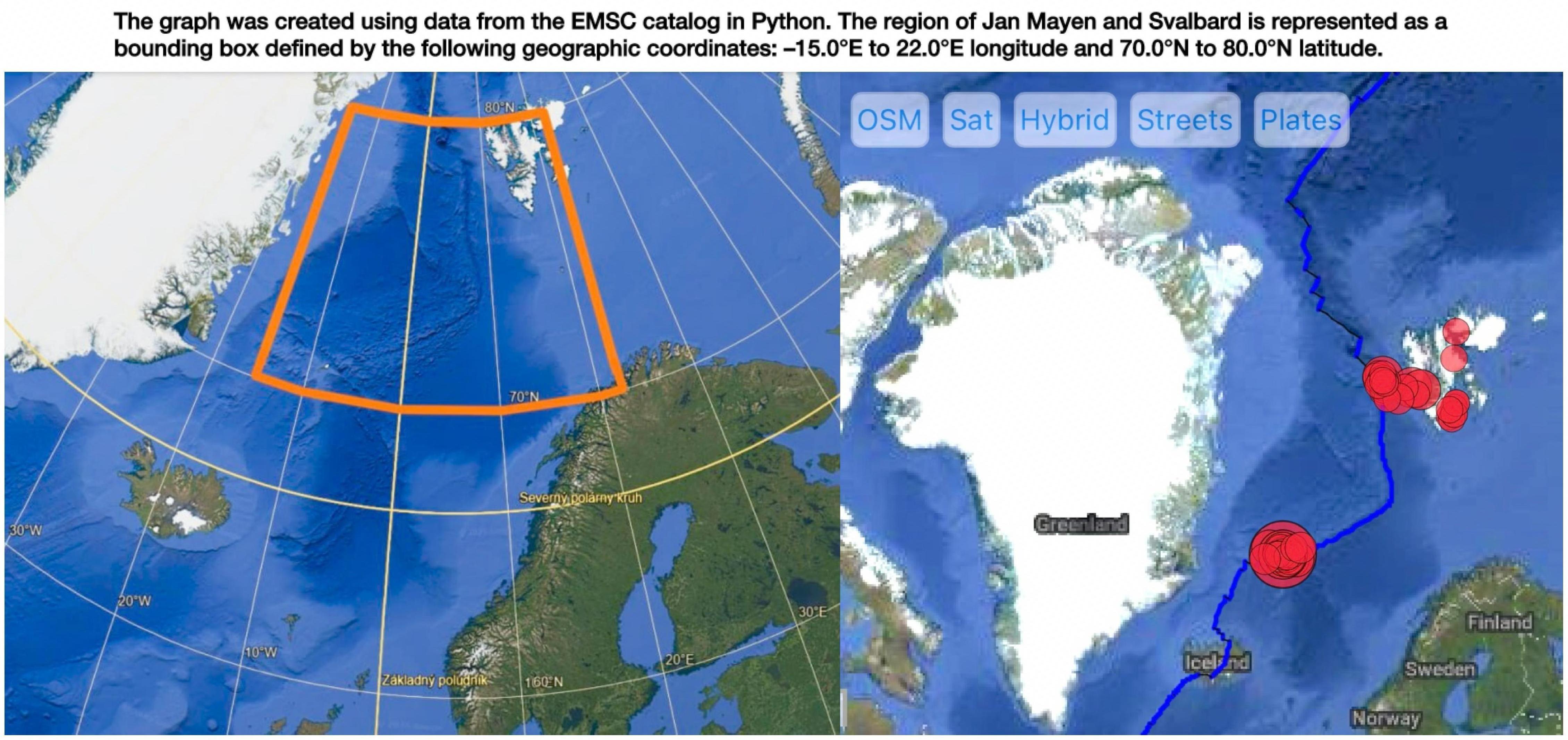
Fig. 2: Analyzed zone around the islands of Jan Mayen and Svalbard, source: Google Earth, own modification (left), earthquakes with M ≥ 4 around the islands in 2025, source: https://www.volcanodiscovery.com/earthquakes/svalbard-jan-mayen/archive/2025.html (right)
For the analysis of seismicity in this region, the EMSC (European-Mediterranean Seismological Centre) database was used, since the Jan Mayen and Svalbard regions are primarily covered by Norwegian seismic networks whose data are regularly published and aggregated via EMSC together with data from other European agencies. Thanks to the relatively dense regional station network, seismicity in this Arctic area has been reliably recorded approximately from magnitude M≈4 and above since the early 1990s.1
Jan Mayen is home to the active volcano Beerenberg, the only active volcano in Norway and the northernmost terrestrial active volcano in the world. In 2025 it has also shown increased seismic activity, which may indicate moving magma beneath the surface.2
The entire seismically most active area lies on the boundary between the Eurasian Plate and the North American Plate. Most earthquakes are concentrated precisely along this fault, highlighting increasing seismic activity along the marginal faults of the Eurasian Plate.
References:
Department of Earth Science University of Bergen (2013) “Seismicity of Norway and surrounding areas for 2013.” Available at: https://nnsn.geo.uib.no/reports/2013/seismicity_2013.pdf (Accessed: March 16, 2026).
Jan Mayen. Available at:https://www.volcanodiscovery.com/de/jan_mayen-earthquakes.html (Accessed: March 16, 2026).