East African Rift: Unprecedented Increase in Activity
The East African Rift is a place where the African continent is literally splitting into two parts. This enormous tectonic system stretches from Lebanon through the Red Sea, Ethiopia, Kenya, Tanzania, all the way to Mozambique—a distance of approximately 6,000 kilometers.
An unprecedented increase in seismic activity was recorded in the East African Rift region in 2025. While the typical annual number of earthquakes with magnitude M 4.5+ in the East African Rift region is usually fewer than 15, in 2025 there were more than 100 (Fig. 1–2).
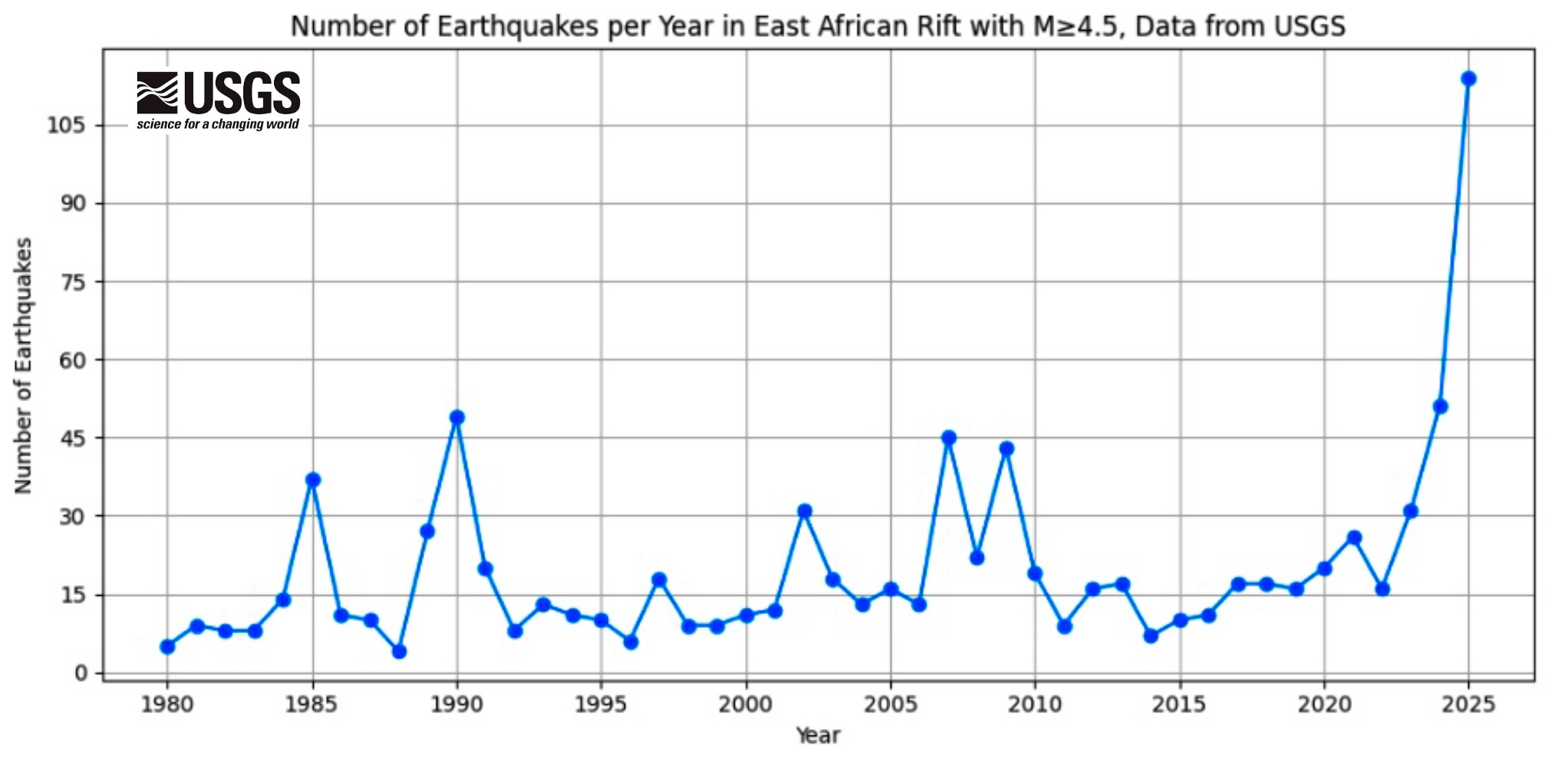
Fig. 1: Number of earthquakes with M ≥ 4.5 in the East African Rift region since 1980, data source: USGS https://earthquake.usgs.gov/earthquakes/search/
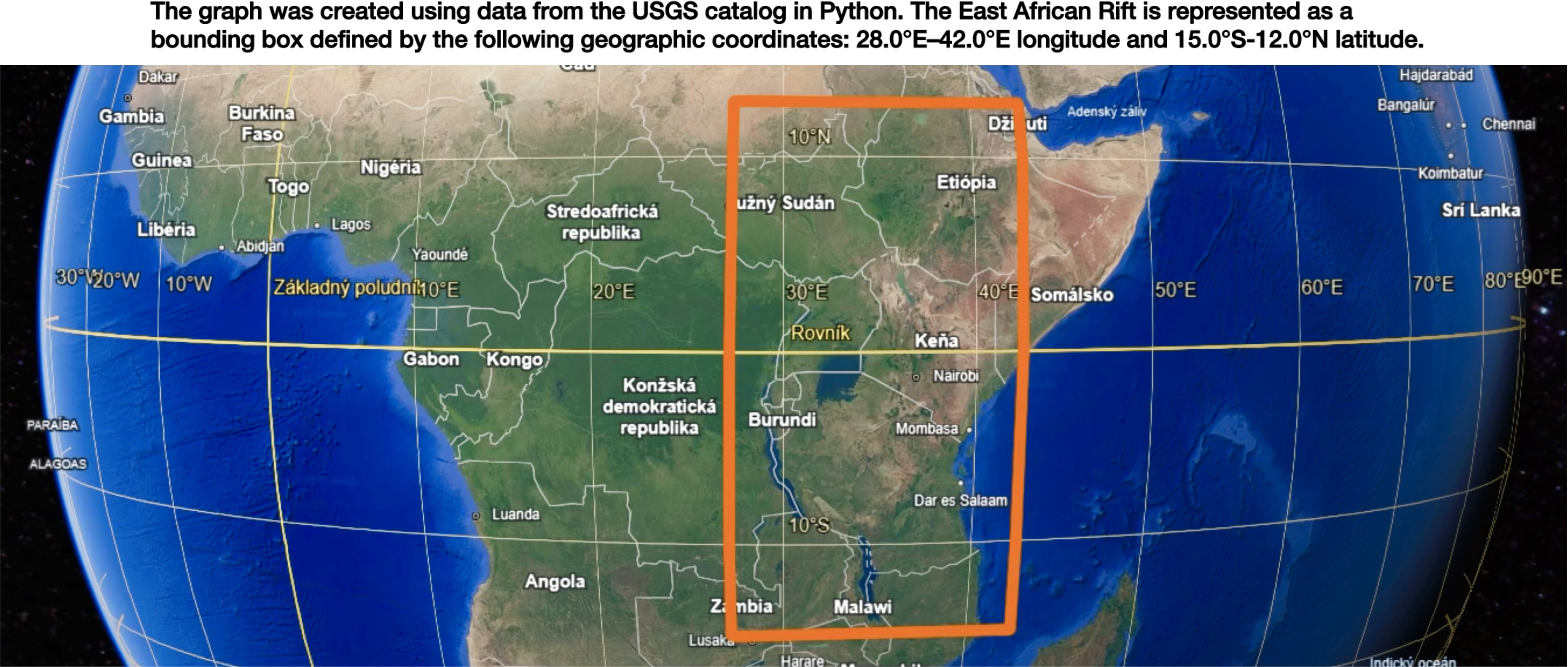
Fig. 2: Analyzed zone of the East African Rift region, image source: Google Earth, own modification
Most of these shocks affected Ethiopia at the beginning of the year, but the region is still not quiet. According to reports, approximately 100,000 people were affected this year and 70,000 people were evacuated.1
A surprising observation occurred in 2005, when a fissure 60 km long and 2 m wide opened within a few days in the Afar region of Ethiopia. This was an unprecedented event—until then it had never been recorded that such an extensive geological change could occur within such a short time, and it had been considered impossible.2
In September 2005, a series of earthquakes began in this region and culminated in the eruption of the Dabbahu volcano. Over the course of several days, magma created a massive intrusion (a subsurface injection of magma) into the Earth's crust, which caused the formation of a 60-kilometer-long fissure. This process, which under normal circumstances should take centuries to millennia, took place within a matter of days.
Awakening Volcanoes
Since then, several volcanoes in the region that had been considered extinct have awakened:
Nabro in Eritrea – erupted in 2011 after more than 10,000 years of dormancy, without any prior warning signs, which surprised geologists. The eruption began on June 12, 2011 and was the first recorded eruption of this volcano in historical times. Ash from the eruption reached a height of up to 13 kilometers and affected a wide region including Eritrea, Ethiopia, and Sudan.3
Dabbahu in Ethiopia – the only known eruption occurred in 2005 after a strong seismic swarm. It was this eruption that was associated with the formation of the 60-kilometer fissure.4
Dofan and Fentale in Ethiopia – began to show signs of activation only this year (2025) after a series of earthquakes. These volcanoes, which had been considered inactive or dormant, are showing increased seismic activity, ground deformation, and gas emissions.5 6 7
Hayli Gubbi volcano in Ethiopia – awakened on November 23, 2025 after 12,000 years (no eruption has been recorded during the entire Holocene). It unexpectedly erupted and produced a massive ash column reaching 10 km above the ground. Experts considered this eruption a highly unusual phenomenon.8 9
In Ethiopia, where the rift is most active, geologists have recorded intense seismic swarms and increased volcanic activity. The Erta Ale volcano, home to one of the few permanent lava lakes in the world, is showing increased activity. In January 2025 there was a significant increase in lava flows, which for the first time in approximately 20 years spread beyond the caldera and reached historic campsites in the area—this is a clear signal of increased eruptive activity.10 In July 2025, a short but intense explosion and dense ash emissions were recorded, signaling another phase of activity beyond its usual quieter state.11
This year a thermal anomaly was also recorded at the Ol Doinyo Lengai volcanic complex in northern Tanzania, the only active volcano producing natrocarbonatite lava (lava rich in sodium and potassium rather than silicate), which is cooler and less viscous than typical basaltic lava. In 2025, Sentinel satellite imagery detected a thermal anomaly above the crater indicating increased thermal activity or potentially exposed hot material close to the surface—something that does not normally occur in this area at such intensity.12
All evidence suggests that a powerful mantle plume beneath Africa has recently become significantly more active, pushing upward new volumes of magma and awakening long-dormant volcanoes.
References:
Ethiopia Earthquake 2025 - DREF Operation (MDRET037) - Ethiopia | ReliefWeb (2025). Available at: https://reliefweb.int/report/ethiopia/ethiopia-earthquake-2025-dref-operation-mdret037 (Accessed: March 16, 2026).
Wright, T.J. et al. (2006) “Magma-maintained rift segmentation at continental rupture in the 2005 Afar dyking episode,” Nature, 442(7100), pp. 291–294. Available at: https://doi.org/10.1038/nature04978.
“Earth Observatory - NASA Science” (1999), 29 April. Available at: https://earthobservatory.nasa.gov/images/event/50989 (Accessed: March 16, 2026).
Dabbahu. Available at: https://www.volcanodiscovery.com/dabbahu.html (Accessed: March 16, 2026).
Dofen. Available at: https://www.volcanodiscovery.com/dofen.html (Accessed: March 16, 2026).
Fantale. Available at: https://www.volcanodiscovery.com/fantale.html (Accessed: March 16, 2026).
Way, L. et al. (2025) “Real-time satellite monitoring of the 2024–2025 dyke intrusion sequence at Fentale-Dofen volcanoes, Ethiopia,” Bulletin of Volcanology, 87(11), p. 100. Available at: https://doi.org/10.1007/s00445-025-01884-3.
Experts On Why Volcano Hayli Gubbi Erupted After 12,000 Years (2025) NDTV. Available at: https://www.ndtv.com/world-news/why-volcano-hayli-gubbi-erupted-after-12-000-years-what-experts-said-9694900 (Accessed: March 16, 2026).
Press, T.A. (2025) Volcano in Ethiopia erupts for first time in nearly 12,000 years: “It felt like a sudden bomb” - CBS News. Available at: https://www.cbsnews.com/news/volcano-erupts-first-time-12000-years-hayli-gubbi-ethiopia/ (Accessed: March 16, 2026).
Yadav, R. (2025) Lava surge at Erta Ale volcano reaches historic camp for first time in 20 years, Ethiopia, The Watchers. Available at: https://watchers.news/2025/01/17/lava-surge-at-erta-ale-volcano-reaches-historic-camp-for-first-time-in-20-years-ethiopia/ (Accessed: March 16, 2026).
Blašković, T. (2025) Sudden eruption produces dense ash plume at Erta Ale volcano, Ethiopia, The Watchers. Available at: https://watchers.news/2025/07/15/erta-ale-volcano-eruption-dense-ash-emission-ethiopia-july-2025/ (Accessed: March 16, 2026).
Szeglat, M. (2025) “Ol Doinyo Lengai: Thermal Anomaly Suggests Lava Overflow | volcanoes and eruptions,” 14 June. Available at:https://www.volcanoes.de/2025/06/14/ol-doinyo-lengai-thermal-anomaly-suggests-lava-overflow/ (Accessed: March 16, 2026).